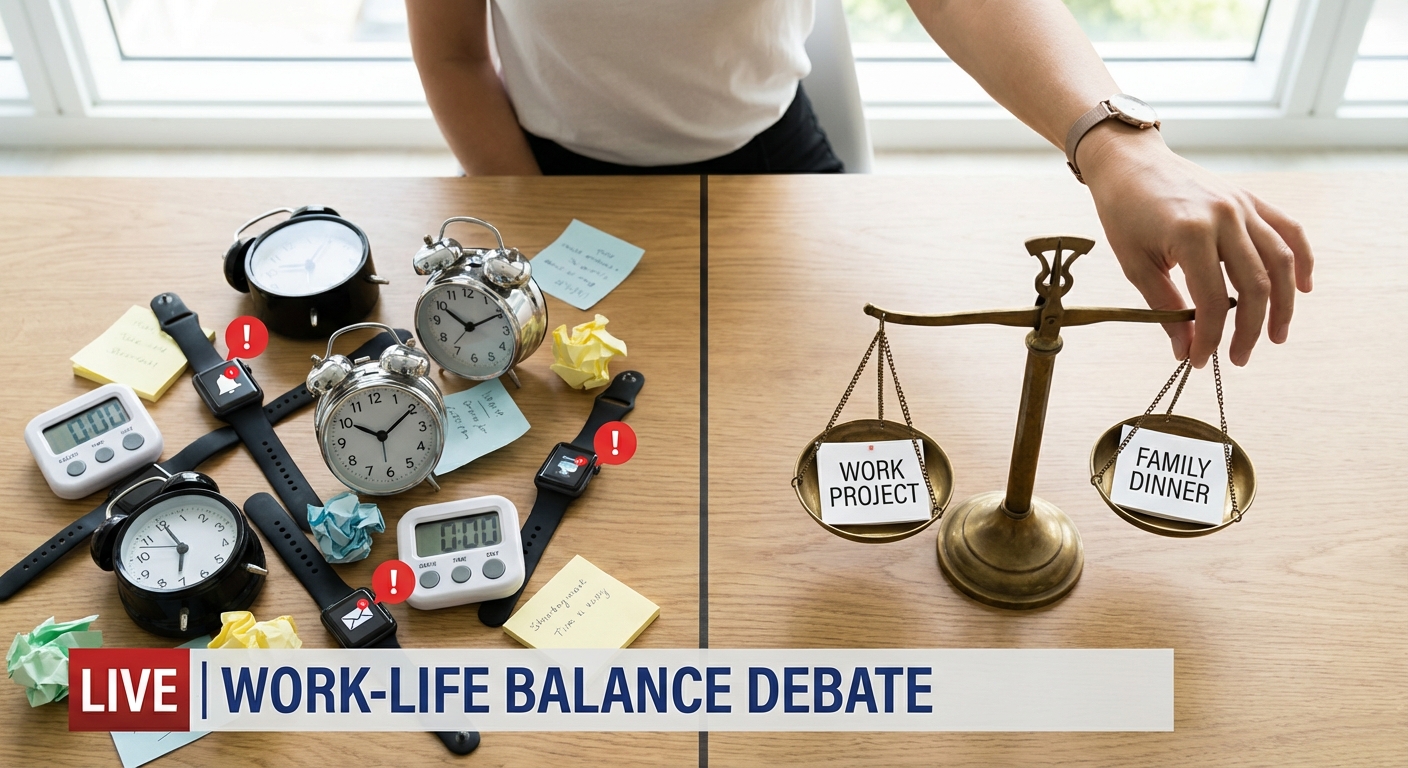
Most people manage time reactively: a growing to-do list, urgent emails, meetings, and whatever is screaming loudest.
Your Time Is an Investment Portfolio, Not a Task Pile
If you managed money the way you manage time—dumping cash on whoever yells—your finances would be a disaster.
A better model: your time is an investment portfolio. Every hour is capital. Some allocations compound, some stagnate, some burn.
Managing time like an investor means:
- Clarifying what "return" means in your life
- Allocating hours across a portfolio of activities
- Rebalancing regularly
Let’s build that from first principles.
First Principles: Defining Return on Time (ROT)
You can’t manage what you don’t define. Return on time is not just money.
Think across four dimensions:
Financial ROT – Increases income, assets, or reduces long-term costs
Capability ROT – Builds transferable skills and knowledge
Relational ROT – Strengthens meaningful relationships and network
Vitality ROT – Improves health, energy, and psychological resilience
High-ROT activities usually hit more than one of these at once.
Example: Learning to sell better can:
- Increase income (financial)
- Build communication skills (capability)
- Improve relationships (relational)
By contrast, low-ROT activities mostly just fill time.
Step 1: Identify Your Core Asset Classes
Investors allocate across asset classes (stocks, bonds, cash). You can do the same with time.
Define 4–6 “asset classes” for your week. For example:
Core Income Work – Tasks directly tied to your paycheck or revenue
Growth Work – Learning, side projects, business-building
Health & Energy – Sleep, training, recovery, therapy
Relationships & Family – Partners, kids, close friends, mentors
Maintenance & Admin – Bills, cleaning, errands, logistics
Leisure & Recovery – Hobbies, entertainment, rest
Your list may differ, but keep it under seven. Anything beyond that becomes noise.
Step 2: Design a Target Allocation
Investors decide: 60% stocks, 30% bonds, 10% cash. You can do the same with hours.
Assume 112 waking hours per week. Subtract an honest estimate for non-movable obligations (work hours, fixed caregiving). Then allocate the rest.
Example for a mid-career professional:
- Core Income Work: 40–45 hours (≈ 40%)
- Growth Work: 8–12 hours (≈ 8–10%)
- Health & Energy: 14–18 hours (≈ 13–16%)
- Relationships & Family: 14–20 hours (≈ 13–18%)
- Maintenance & Admin: 6–10 hours (≈ 5–9%)
- Leisure & Recovery: 10–16 hours (≈ 9–14%)
This isn’t about precision; it’s about intentional ratios.
The key question: Given the life I want in 3–5 years, does this allocation make sense?
If you want a different career but have 1 hour of growth work per week, the answer is no.
Step 3: Convert Allocations Into Calendar Blocks
Portfolios are abstract until money is actually invested. Same with time.
For each asset class, create concrete blocks in your calendar:
- Growth Work (10 hours):
- Mon–Thu: 6:30–7:30 a.m. (deep practice or side project)
- Sat: 9–11 a.m. (longer block)
- Health & Energy (15 hours):
- Sleep: 7 hours/night (49 hours, foundation)
- Training: 3 × 60 minutes
- Walks: 5 × 30 minutes
- Relationships & Family (15 hours):
- 3 dinners fully offline
- 1 date night
- 1 long call/meet-up with a friend or mentor
Blocks turn aspirations into commitments.
Step 4: Evaluate ROT for Recurring Activities
Now audit your recurring time investments like an investor reviewing holdings.
For each recurring meeting, habit, or obligation, ask:
What type of return does this produce? (financial, capability, relational, vitality)
Is the return high, medium, or low?
Is there a cheaper way to get the same return?
Examples:
- A 60-minute weekly status meeting → convert to a 15-minute standup or async doc
- Doing your own bookkeeping → hire a professional and reclaim 3–5 hours/month
- Social media usage → reduce to a specific 20-minute window, or move to desktop only
You’re pruning low-yield investments to reallocate to higher yield.
Step 5: Build an Upgrade Pipeline
Investors don’t just hold; they constantly seek better opportunities.
Create a running list called Time Upgrades with two columns:
- Replace: activities you want to reduce or eliminate
- With: higher-ROT alternatives
Example:
- Replace: 1 hour of nightly aimless TV
With: 30 minutes of reading + 30 minutes of deliberate relaxation
- Replace: 3 low-impact meetings/week
With: 2 hours/week of focused deep work on a key project
Each week, implement 1–2 small upgrades. Compounding works in time as much as in money.
Step 6: Weekly Rebalancing Ritual
Portfolio rebalancing keeps you aligned with your strategy.
Once a week, take 15–20 minutes:
Review Actual vs Target Allocation
"I planned 10 hours of growth work; I did 3. Why?"
Inspect Biggest Misallocations
Where did unplanned time go? What pulled you off track?
Adjust Next Week’s Calendar
Move, shrink, or remove blocks based on what you learned.
This is not guilt time. It’s data review.
Practical Example: Mid-Career Pivot
Say you’re a software engineer who wants to move into product management in 2–3 years.
Your portfolio should reflect that trajectory:
- Growth Work: 8–10 hours/week focused on product skills:
- 3 hours reading product case studies
- 3 hours building mini product specs or mock projects
- 2–4 hours talking to PMs, shadowing, or contributing to product decisions at work
- Core Income Work: 40 hours, but skew tasks toward cross-functional work where possible.
- Relationships: deliberately invest in product leaders who can mentor or later sponsor you.
If your time portfolio shows none of this, the pivot is wishful thinking, not a plan.
Handling Seasons and Crises
Investors sometimes go defensive: more cash, fewer risky bets. Your time portfolio should also flex by season.
- Crisis season (illness, family emergency):
You deliberately reduce Growth Work and ambition. The goal is survival and preserving Tier 1.
- Surge season (big career project, launching a business):
You temporarily over-allocate to Core Income/Growth Work and simplify everything else.
The key is that shifts are conscious, with clear start and end criteria.
You Are the Fund Manager of Your Life
You’re already investing your time. The question is whether you’re doing it intentionally.
Managing your week like a portfolio pushes you to:
- Define what "return" actually means for you
- Allocate hours in line with your real goals
- Prune low-yield uses of time without drama
If you consistently invest in high-ROT activities, small weekly improvements compound into a radically different life over a few years.
You don’t need a perfect system. You just need to stop treating your time like an infinite resource and start managing it with the seriousness it deserves.